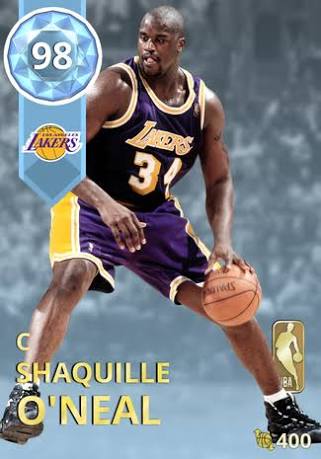
 The center is considered a necessary component for a successful team, especially in professional leagues such as the NBA. But recently, the NBA has turned into a point guard league and many centers are shooting threes now. Great centers have been the foundation for most of the dynasties in both the NBA and NCAA. The 6’10” (2.08 m) George Mikan pioneered the Center position, shattering the widely held perception that tall players could not develop the agility and coordination to play basketball well, and ushering in the role of the dominant big man. He led DePaul University to the NIT title, then, after turning professional, won seven National Basketball League, Basketball Association of America and NBA Championships in his ten-year career (1946–56), nine of them with the Minneapolis Lakers. Using his height to dominate opposing players, Mikan invented the hook shot and the shot block; as a consequence, the NCAA, and later NBA, adopted the goaltending rule, and, in 1951, the NBA widened the foul lane, a decision known as the ‘Mikan rule’.[1]
Category: Uncategorized
Power Forward (PF)
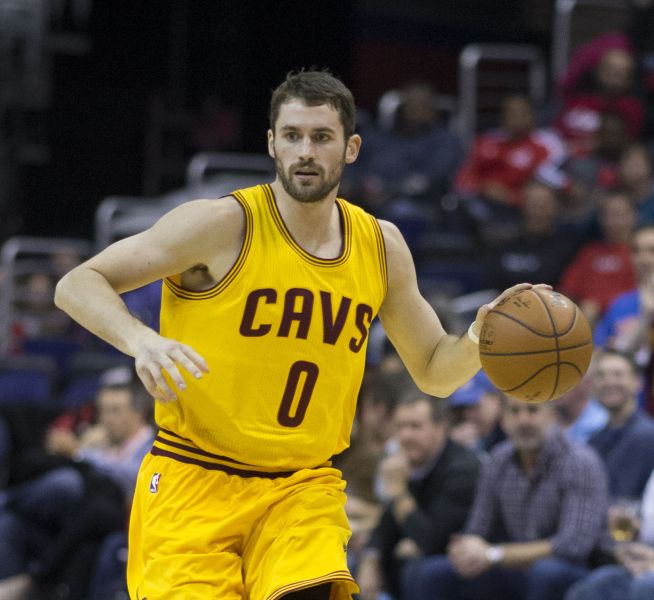
Small Forward (SF)
The small forward (SF), also known as the three, is one of the five positions in a regulation basketball game. Small forwards are typically shorter, quicker, and leaner than power forwards and centers, but typically taller and larger than either of the guard positions.The small forward is considered to be perhaps the most versatile of the five main basketball positions.[1] In the NBA, small forwards usually range from 6′ 6″ (1.98 m) to 6′ 10″ (2.08 m) while in the WNBA, small forwards are usually between 5′ 11″ (1.80 m) to 6′ 2″ (1.88 m).
Shooting Guard (SG)
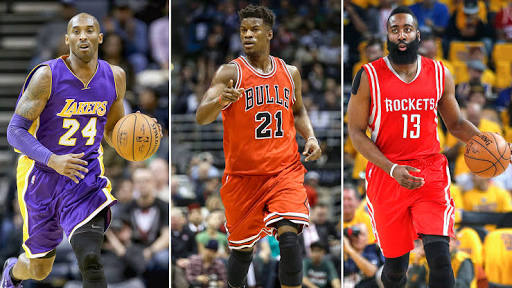
The shooting guard (SG), also known as the two or off guard,[1] is one of the five traditional positions in a regulation basketball game. A shooting guard’s main objective is to score points for his team and steal the ball on defense.[1] Some teams ask their shooting guards to bring up the ball as well; these players are known colloquially as combo guards. A player who can switch between playing shooting guard and small forward is known as a swingman. In the NBA, shooting guards usually range from 6′ 3″ (1.91 m) to 6′ 7″ (2.01 m) and 5′ 9″ (1.75 m) to 6′ 0″ (1.83 m) in the WNBA.
Point Guard (PG)
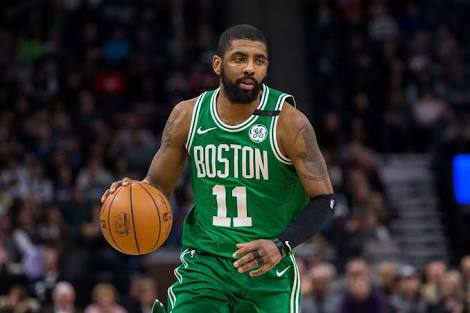
The point guard (PG), also called the one or point, is one of the five positions in a regulation basketball game. A point guard has perhaps the most specialized role of any position. Point guards are expected to run the team’s offense by controlling the ball and making sure that it gets to the right players at the right time. Above all, the point guard must totally understand and accept their coach’s game plan; in this way, the position can be compared to a quarterback in American football or a playmaker in association football (soccer). While the point guard must understand and accept the coach’s gameplan, they must also be able to adapt to what the defense is allowing, and they also must control the pace of the game.
The Journey Begins
Thanks for joining me!
Good company in a journey makes the way seem shorter. — Izaak Walton

 Different position in basketball